Archive for the ‘China’ Category

Recycling the trash

Friday, December 17th, 2010

In Japan, and several other countries, household trash needs to be separated into various categories and those categories of trash are put outside for collection on predetermined days. Common categories may be metals, plastics, glass, combustible, noncombustible, etc. The main reason for this is to increase the amount of recycling and decrease the amount of trash that ends up in landfills.

Here in Qingdao though, all trash can be thrown out together on any day of the week. That makes life much simpler for the average household, who probably wouldn’t separate it anyway, and means that the trash is collected daily.

But, what about recycling? How can glass bottles, metal cans, plastic containers, paper, etc. be efficiently recycled if they are not separated before being collected? Surely this leads to much more usable resources ending up wasted in landfills?

No, not here in Qingdao. There are many people whose job it is to collect a certain type of resource (aka trash). I’ve already explained to you about how I dispose of my empty beer bottles. There are also people that only collect plastic bottles, metal objects, paper, etc. Sometimes people will call them to collect those items, but a majority of their work consists of going through the public trash cans that can be found on most residential streets.

I can go out at 6:00pm in the evening and walk past dozens of trash cans overflowing with all manner of trash, and often with several plastic bags of trash surrounding them as the trash cans were already full. However, when I walk home at 11:00pm, those trash cans are near to empty; they are generally left with only those items that are of no value, can’t be recycled, and would end up in the landfill anyway.

At first, the site of people digging through the trash collecting plastic bottles seemed degrading and sad. However, on reflection, it is just society’s way of separating the trash, increasing recycling, and giving many people jobs. It doesn’t seem so bad after all.

Problems with landlord – Part 2

Wednesday, December 1st, 2010

Following on from before . . .

After leaving China on the 30th August with the landlord threatening to have a locksmith open the door and change the lock, I returned to a busy schedule in Japan.

Two lawyers and the real estate agent assured me that not even this crazy landlord would be so stupid as to have somebody open the door without my permission as that would be a clear breach of several laws, and that the only way he could gain access to the room was if I were to open the door. Since there was no way I was going to do that, I felt sure that it would just be a problem to return to when I came back to Qingdao in October after the Chinese holiday (October 1st to 7th).

Of course, I should have learnt by now: nothing is ever that simple.

On about the 28th of September, some workmen arrived asking my staff to open the apartment above so they could replace the water meter. This was being done in every room in the building, and that in itself wasn’t a problem. What made me suspicious was that the landlord was there as well. Since the landlord was there, I told my staff that they were not to open the door, and that even if the whole building had its water turned off for an extended time, it was just because the landlord wouldn’t fulfill his legal obligations when we terminated the contract—paying me my money back!

But, the workman, a lady from the office responsible for maintaining the entire complex (six buildings), the landlord, as well as my staff all said that I should allow the water meter to be changed as it wouldn’t alter our situation. So, on the condition that the landlord left after the work was completed (about 30 minutes) and was not allowed to change the locks, I somewhat reluctantly agreed to have the door unlocked.

As soon as the door was unlocked and the water meter was being changed, the landlord had a locksmith change the locks, and told my member of staff to keep it a secret and pretend that he had done it himself during the holiday period. Apparently there was nothing she could do to stop him.

She reported the story to me that evening, and I was left with a couple of weeks to consider my alternatives about what to do with the moldy apartment for which although I didn’t even have a key, was still paying the rent. This time the landlord had really gone too far, and would surely lose any court case about it, so I decided to leave things as they were until I returned on the 8th of October, and just had a member of staff contact a local Chinese lawyer to investigate my options.

Old Stone Man, Qingdao

Friday, October 22nd, 2010

Shilaoren, which means “Old Stone Man”, is one of Qingdao’s most popular tourist beaches. It was named after the shape of the prominent rock outcropping located just off the Shilaoren Peninsula. The rock is said to resemble an old fisherman waiting for his daughter to return from beneath the waves. The daughter was taken by the dragon prince who later turned the waiting father into stone.

Simplified Chinese

Tuesday, October 5th, 2010

Chinese has two main character sets: traditional and simplified.

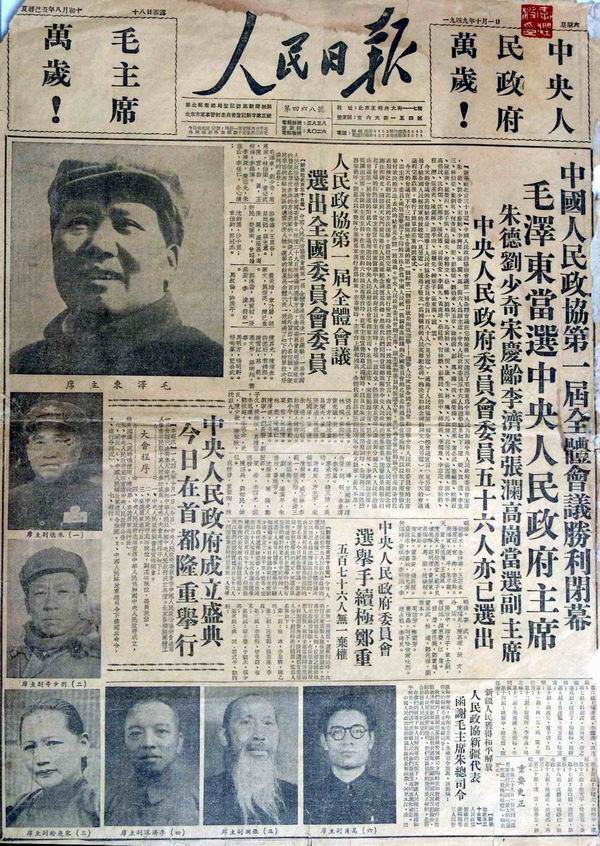
Most of the simplified Chinese characters used now are due to the government of the People’s Republic of China (PRC) in the 1950s and 1960s. However, the simplification of Chinese characters has its origins long before the formation of the PRC in 1949. When Chinese is written in cursive text, there is almost always some simplification of characters. This has been true since as early as the Qin Dynasty (221 – 206 BC).

The People’s Republic of China announced its first two lists of official simplified characters in 1956 and 1964. You can see from this newspaper that traditional characters were still being used when China was officially reborn as the PRC on the 1st April 1949.

The People’s Republic of China, Singapore and Malaysia use simplified characters for almost everything. However, they are still quite rare in printed text produced in Hong Kong, Taiwan, Macau, and overseas Chinese communities. This is changing as China opens up to the world and there is more information exchange between the many Chinese communities. On the other hand, there is an increase in the use of tradition characters in mainland China on signs and in logos.

While the basic principle of the simplification of the traditional characters is to make them easier to remember and write, there is some confusion as some characters are not only simplified, but reborn as totally different characters. One example of this is the character used to mean “leaf”:

Tradition character:

Simplified character:

It is interesting to note that these two characters both exist in Japanese as well, but one has a totally unrelated meaning:

[ha] means leaf, while (う) [kana(u)] means fulfill as in to realize a dream.

Another interesting exception to the idea that all simplified characters are simpler (fewer strokes) than their traditional counterparts is the character for “strong”:

Tradition character: (11 strokes)

Simplified character: (12 strokes)

Another interesting simplification does not change the stroke count of the character at all, but is just reverses the position of the left and right sides of the character. It is the character for “enough”:

Tradition character:

Simplified character:

Drink menu

Friday, September 24th, 2010

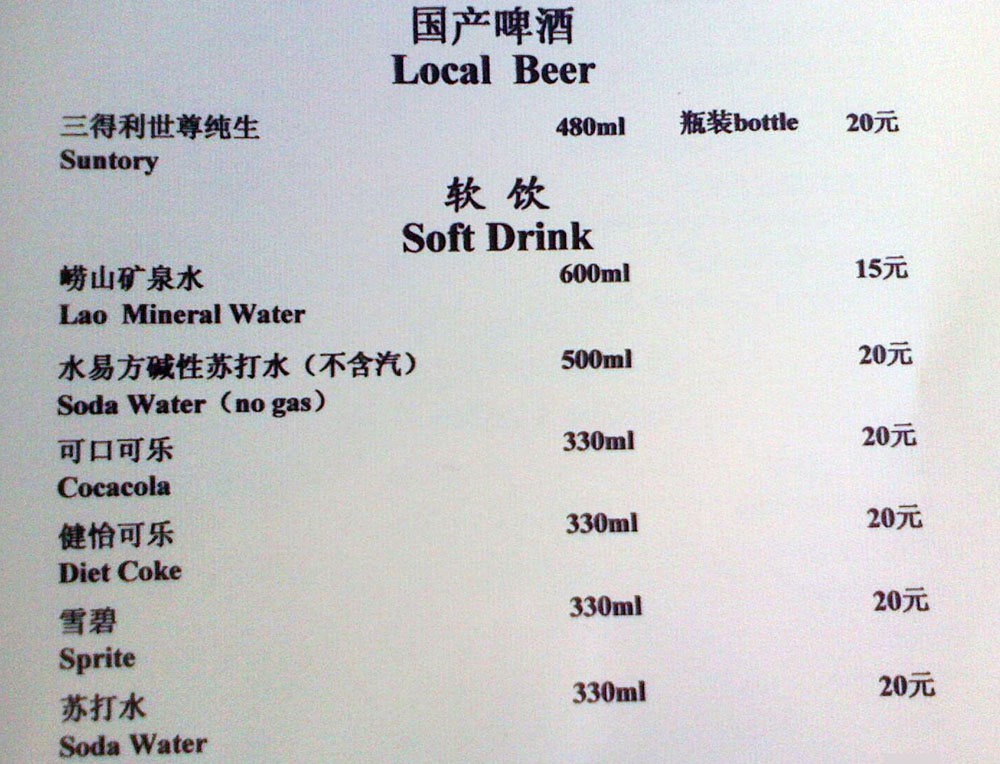
This is part of a drink menu from a large Chinese restaurant in Dalian. Two things jumped out at me. First is the fact that the only local beer is in fact a Japanese beer. It is, no doubt, brewed locally, but . . .

The second curious item on the menu is “Soda Water (no gas)”. What is soda water if you take the gas out?