Archive for April, 2010

Living on promises

Thursday, April 29th, 2010

It seems that the use of promissory notes is far more common in Japan than in other countries. Quite often a large company will only outsource work to a smaller company if they agree to the payment conditions set by the larger company that often include being paid by a promissory note if the monthly invoice total exceeds a certain amount. These amounts can be as low as 100,000 yen (approx. US$ 1,000), and the amount of time it can take before the promissory note can be cashed can be up to 150 days.

So, in Japan, where it is common to bill for work at the end of the month and receive “payment” at the end of the next month, if the payment is a 150-day (5-month) promissory note, you could find yourself delivering something on the 1st of January, billing for it on the 31st of January, receiving a promissory note at the end of February, and only getting your hands on the cash at the end of July. That’s seven full months after delivery!

While it is possible to use the promissory notes as collateral for short-term loans, it effectively means you are paying interest for the five months, and taking the risk of having to pay the money back to the bank should your client not have sufficient funds in the designated account when the promissory note is due.

This means that small businesses in Japan are being used as de facto financial institutions by their clients.

Fair? Maybe not. Common? Yes, in Japan.
Fake or just different?

Friday, April 16th, 2010

Is there anything that isn’t copied in mainland China? I can’t think of anything right now. What can’t be copied is imitated to a degree somewhere between flattering and illegal, perhaps covering both ends of the spectrum.

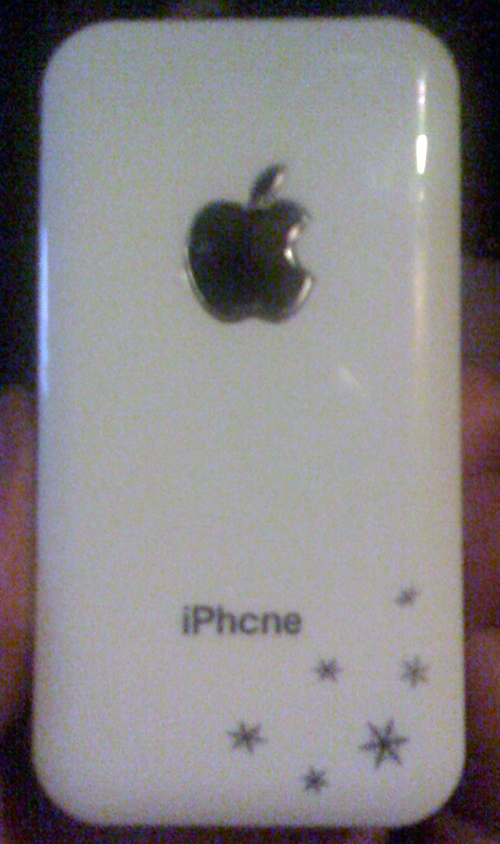
This is a mobile phone I came across last time I was in China (last month). While at first glance it appears to be an iPhone complete with Apple’s logo, a closer inspection reveals that despite the apple mark, it is not an iPhone, but an iPhcne.

While it does have a touch panel display, it is a fold-in-two normal mobile phone, and function-wise doesn’t bear any resemblance to the real iPhone.

I used to look for various spurious items in China. My mission now is to find something that isn’t copied.

Right tool for the right job

Tuesday, April 13th, 2010

The psychologist, Abraham Maslow, said that, “If the only tool you have is a hammer, you tend to see every problem as a nail.” It seems that many people who are more comfortable using MS-Excel use it for things for which it was never designed. MS-Excel is a spreadsheet application used mainly for creating lists and automating calculations. However, many people—especially engineers—seem to prefer it to more suitable applications such as its friend, MS-Word, for creating instruction manuals, quality manuals, and various other documents that would be better created with a word–processing application than a spreadsheet.

The document they create may look fine when printed and serve its initial purpose. However, it can go on to be a translator’s nightmare. When the translation is longer than the original, the translation often doesn’t fit into the same cell, and trying to resize cells or text boxes can result in a total mess, and takes much more time than the same translation would have if a more suitable application had been used to create the original.

Pages don’t flow naturally; text is often broken between various cells, meaning that it is much more difficult—or sometimes impossible—to use a CAT application to speed up the translation work.

So, the end result is frequently a less-than-perfect job that takes more time, and costs more money than it would have, and should have, if the original document had been created with an appropriate application.

Every tool has its purpose. Excel’s purpose is not writing pages and pages of text. Why do you think they named MS-Word “Word”?

Holding hands

Sunday, April 4th, 2010

Different countries, different cultures, different norms. Nothing to be surprised about.

Yet, much of what people see in other countries does surprise them. One example is people holding hands in public.

Close your eyes and imagine two people walking down the street holding hands. Now, is one male and the other female, or are they of the same sex? Your answer is likely to be highly dependant on where you are from.

While in the UK, USA, and Japan, the only time you would see two adults holding hands would be when they are romantically involved couple, normally (but not always) male and female.

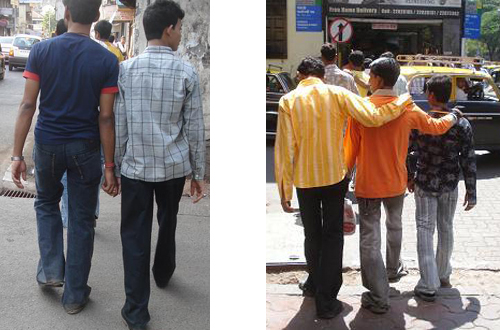
However, this is not true in all countries. For example, it is very common to see two young women walking down the street holding hands in China, and the same with two young men in India. It is not a sign of any romantic affection, just of friendship.

Women holding hands in China


Men holding hands in India