Context is everything

June 14th, 2010

I am often asked to translate a single sentence (or even a lone word). That, however, is unrealistic at best, and often impossible. The best you could do is giving a dictionary equivalent for each word and massage the grammar so it meant something. There is, however, a great chance that it won’t mean what it did before it was “translated”. Depending on the language, there is often information needed for the translation that is not in the sentence.

Every language has its own grammar and rules. When two people are communicating in that language, there are relatively few misunderstandings as both people know what the conversation is about, and understand the nuance of the words being used. However, when you are faced with just a small part of a conversation, it is often impossible to translate it accurately and naturally without extra information.

For example, in Japanese, there are two main words used to mean “father”: one indicates that it is your own father, and the other that it is not. There is, however, no other word necessary to indicate whose father when both parties to the conversation already know that fact. Also, there is no distinction between singular and plural nouns.

So, the following two sentences could result in the same Japanese.

(お父さんは犬の散歩をしている。)

His father is walking the dog.

Your father is walking the dogs.

Without asking questions and finding out whose father and how many dogs, it is impossible to correctly translate even this simple sentence.

A similar situation can arise when translating from English or Chinese into Japanese. For example, the simple sentence, “I will also go to Tokyo.” has two meanings. Without knowing whether there is another person or another place involved, it is impossible to know what the “also” refers to. In Japanese, however, the position of the “also” in the sentence makes it clear, and you therefore have two sentences.

The opposite is also a problem as both the Japanese sentences would often be translated into the same English or Chinese, leaving the reader wondering what was really being meant.

When translating, it is important to know the background, understand what information is really meant to be conveyed with the sentence, and then render it into the other language.

Translate the meaning, not the words!

Qingdao Beach – 1

June 9th, 2010

As the Chinese summer school holidays haven’t started yet, there are still very few tourists from the many inland provinces of mainland China that don’t have a coast. However, the beaches for which Qingdao is famous are already starting to become busy with people playing in the sand and sea.

The sea breeze was pleasant, but it will only get hotter from now on . . .
Unfortunately, it seems that not only are BBQs not allowed, but dogs aren’t permitted to enjoy a stroll along the beach.

Cars but no parking

May 29th, 2010

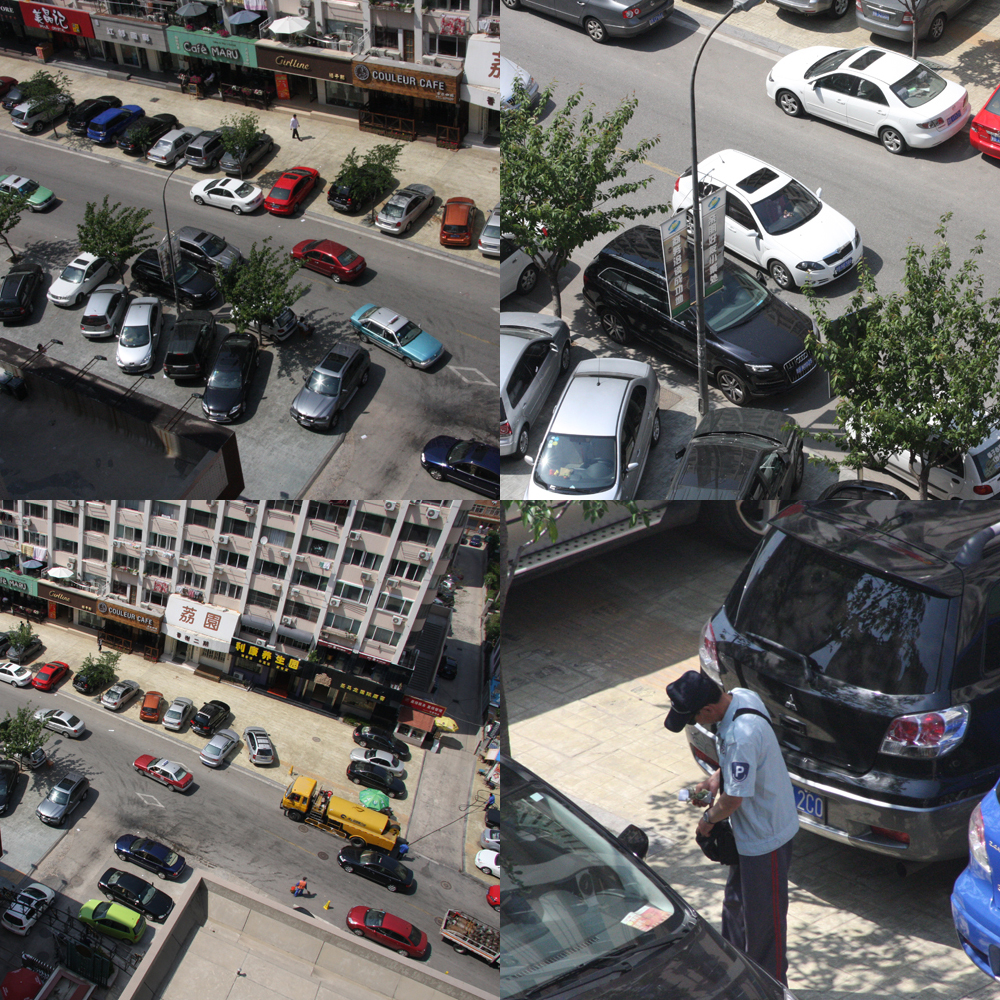
At the moment, you don’t need a parking spot in order to buy a car in China, and the number of cars is rapidly increasing. There are more and more cars on the road each month, yet there is nowhere to park them. As of January 2010 in Qingdao, there were approximately 1,500,000 registered cars, and that is 160,000 more than the previous year. In the same year, 200,000 or so people acquired a driving license. At the moment, the number of cars on the roads in Qingdao is increasing by 600 a day. That’s equivalent to 220,000 cars a year.

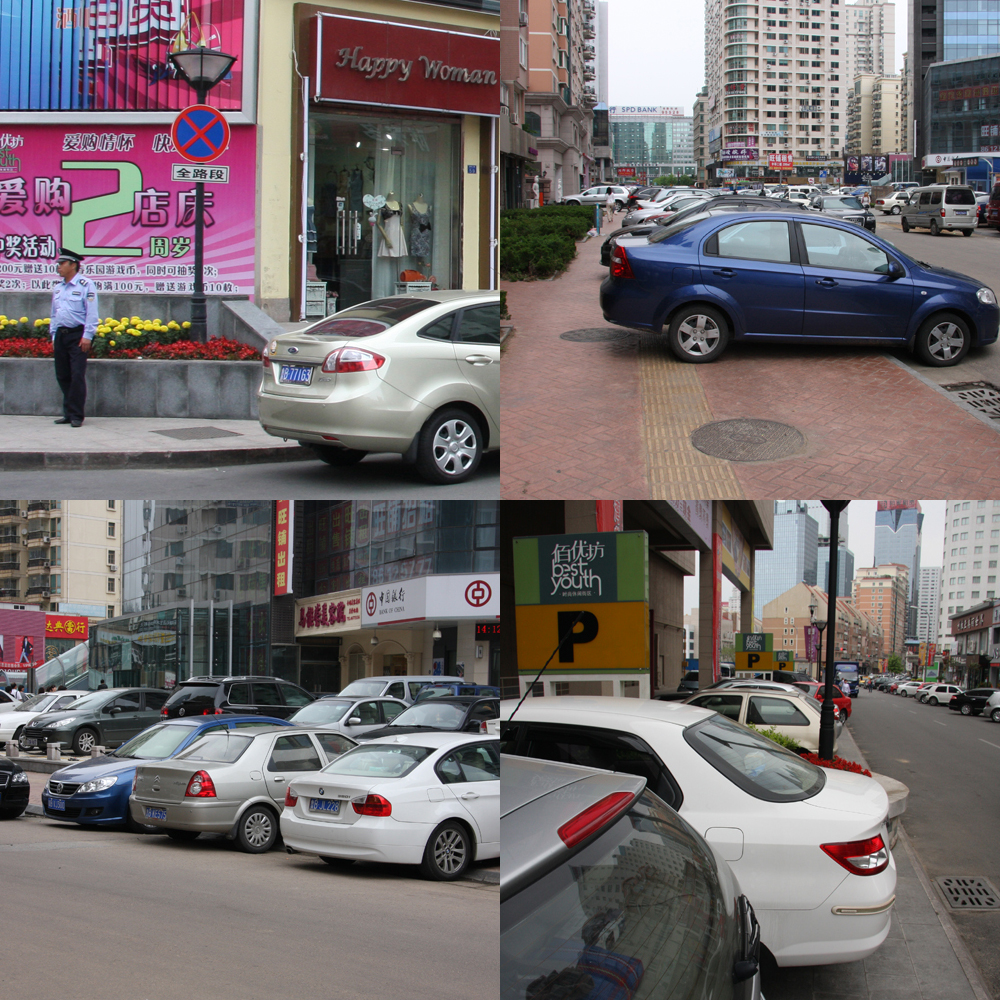
While the number of cars is increasing, the number of parking places is not. There are places along the side of the road, next to the pavement, carefully marked with white lines indicating where to park. However, these are just not sufficient for the number of cars that need a place to be parked, so the lines are ignored, and people park their cars on the pavement itself. The pavement, where people are supposed to walk, is now a parking lot.

This de facto parking lot is not free. It costs about 2 RMB for an hour. Of course, if you don’t need an official parking ticket (receipt), you can just give the man collecting the parking fees 1 RMB, and he will just put that in his pocket, avoiding the necessity to issue the bothersome ticket!

Since there are so many cars parked on the pavement, pedestrians are forced to walk in the road. The yellow bricks with Braille-like markings for the visually impaired are totally covered by parked cars rendering them meaningless.

Every time I come to Qingdao, I think, “Well, that’s about as many cars as there is room for”. However, there are always more the next time.

Where are they going to park them when the pavements are full . . . ?

These photos were taken from my office window, where the streets have quite a wide pavement.

However, no matter how narrow the pavement is,
the situation is the same.

Even when there is a policeman standing
right under a “No parking” sign . . .

How we met

May 24th, 2010

I’m British and my wife is Japanese. We are always being asked how we met.

In 1998, I went back to England for the first time after leaving in 1991. The cheapest flight I could find was Hiroshima to London via Singapore. On the same day my wife left Japan to spend a year in England studying English. She also looked for the cheapest flight she could find, and ended up flying from Tokyo to London via Singapore. So, we ended up on the same flight from Singapore to London.

It was a large aircraft with 3 seats, 4 seats, and 3 seats across. I was seated on the leftmost seat in the middle, and my wife was seated on the rightmost seat. In between us was a married couple, with the wife sitting next to me. From the moment I sat down, the lady next to me started to ask me questions. The first was, “Where are you going?” which seemed a little strange since we were sitting on an aircraft bound for London.

The questions continued.

Where do you live?  :  Japan

What do you do there?  :  Translation and interpreting

Can you speak Japanese?  :  Yes

Is she (girl three seats away from me) Japanese?  :  No idea!

As soon as I said I didn’t know where the girl was from she leaned across her husband and asked, “Are you Japanese?” The somewhat confused girl gave her a puzzled look and just answered, “Yes.” That was enough. As she was explaining, “He speaks Japanese, so you should sit here”, she was already standing up and removing her baggage from the overhead compartment. The aircraft was already taxiing along the runway, and the stewardesses were all buckled into their seats, but that didn’t stop her from switching seats with the girl in the other aisle. Looking back now, I think she just wanted an aisle seat for herself, but it was all over before anybody could stop her, and there we were for the next 15 hours.

The girl that had been planted next to me was on her way to the UK to study English. She had worked three jobs to save up enough money, and hadn’t borrowed anything from her parents. She didn’t speak any English at all, and said that she thought it would be better to just go to the UK and learn than waste time and money trying to study in Japan. After the 15-hour flight, we arrived at London’s Heathrow Airport and collected our suitcases. She was obviously confused about where to go and what to do, I decided to help her through the immigration procedures, and help her find the person from the English school that was there to meet her. On finding the correct school, and confirming that her name was on the list, I turned to go back to my father who had come to meet me. She still seemed unsure of herself, and a little scared, so I explained that while I would be going to Mexico with my parents for a couple of weeks, and then returning to Japan six weeks later, that if she had any problems she could always call my parents who would try and help. So, I wrote down my parents’ telephone number for her, and left to find my father. I didn’t know her family name, and never imagined that she would get in contact.

However, . . . the evening before I was scheduled to return to Japan, she called my parents’ house. “Thank you for your help that day. I’m settled in at my home stay now. I’d like to send you a postcard, so please tell me your address”. I didn’t really expect her to send a card, but told her my parents’ address in the UK. And, as planned, I returned to Japan the next day.

A couple of months later, my parents told me that a postcard had arrived. I just told them to send it out the next time they sent something. The postcard eventually arrived, so I sent a postcard back. Then a letter came, so I replied with a letter. We kept in touch while she was in the UK by letter, and then by email when she returned home (to Saitama). One day, she asked if she could “come and see Fukuyama”, and so she did. That was October 1999, more than a year after we had met on the plane. We met again in Tokyo when I went there on business, and agreed that she would spend the New Year’s holiday in Fukuyama. Over the New Year we decided to get married. That was the fourth time we had met. I went to visit her parents in February, and she moved to Fukuyama on the 1st of May 2000.

International marriages involve some paperwork and time, and when that was all prepared we decided to register our marriage on the second anniversary of the day we met on the plane.

Alcohol and business dinners

May 18th, 2010

If you think that alcohol and business don’t go together, perhaps you’d better stay away from China. They don’t only go together; I’d go so far as to say, “no alcohol, no business”. While the concept of discussing business or just getting to know people during dinner and a drink may be commonplace in many countries, China takes it a step further.

My first visits to China were as a member of a group of businessmen from Japan invited to see various cities in China, and be encouraged to “invest” in their cities, which each had their attractions and carefully-named “development zones”.

Typically, our group would consist of half a dozen members, and we would be greeted by high-ranking officials from the local municipality, managers of the development zones, local businessmen involved in international trade, and various other bodies to fill the room and totally outnumber us. At first, it seemed as though this was all part of the VIP treatment that we normally received, which often also included police escorts into town through red lights and all. But, first impressions can be deceiving, especially in China . . .

So, the first morning, after taking a tour of a (partially developed) development zone, we would be invited (taken!) to lunch with a dozen or so local people. They would range from factory managers to the mayor. In addition to the beer (served cold if we were lucky), we would be treated to the local variety of white spirit (baijiu). This ranges in alcoholic content from about 35% to 75%, and in taste from bad to worse.

The tradition, if that’s what you call it, or custom is for each person on the visiting side of the table to drink a glass of this local spirit with everybody on the welcoming side of the table. Remember, that’s six of us and at least twelve of them. Yep, it’s an us and them game! Competitive drinking at its worst. With six of us, and twelve of them, it means that for every “round” of drinks, we each get to drink twelve glasses, and they each get to drink six. If that doesn’t sound fair, it is only later that you learn how they are often only drinking water or tea, while you are being treated to the local 55% alcohol fire-water. And, it’s still just lunchtime!

After another tour of a port, or maybe a two-hour seminar (a good place for a sleep) with impossible-to-comprehend literature (they tell it’s been translated into your language, but . . .), you get 30 minutes in your hotel room before the dinner starts at about 6:30 pm.

Dinner is usually a selection of the best the region can offer. This can range from sea cucumbers, scorpions, and fried insects to things you can’t recognize but don’t have the courage to ask about. And, yes, of course, the drinking. It is basically the same as at lunch but with the volume turned up: bigger glasses and more toasts.

After dinner, you are typically taken drinking at a local karaoke establishment where you are looked after by young ladies that speak your language. There, the normal beverage is warm beer.

Why drink that much?

Well, they don’t drink so much as make sure that their guests do. There are varying reasons given for this, but the most convincing to date is that people tend to reveal their true selves when they are somewhat inebriated, and the Chinese like to see the true person, flaws and all, before they even consider doing business with them. Another reason given, which I have experienced myself numerous times, is that they will ask the same question several times from different angles. At first it seems as though they are either stupid or forgetful, but they are not. They are calculative, smart, and relatively sober! They will ask you about a date. When that was, how old you were then, how many years ago it was, how old you are now, etc. They are, of course, making sure that the answers you gave at lunchtime, before you started drinking, and after you are suitably pickled are all the same. Not a problem, as long as you are telling the truth.

How to avoid drinking

Basically, you can’t. Unless you tell them the very first time you meet them that you do not drink—cannot drink—any alcohol, you will be socially obliged to drink “just a little”, and that soon escalates into “just too much”. Even taking a sip for the first toast is enough to let them know that you can drink if you want to.

Not drinking is an option, as is stopping when you feel you have had enough. However, you should be aware that refusing their drinks is tantamount to refusing their business.

Interpreters

I’d also warn you to beware of the young ladies from the local municipal offices that are brought along as your interpreters. It is quite often that they will not be able to finish their glass of whatever is being drunk at the time and you, as a gentleman, will be expected to drink it for them. It isn’t unusual for these interpreters to ask for red wine as they “really don’t like the baijiu” (as if any of us do!), and then just take a sip leaving you to finish the glass of wine after your warm beer and baijiu.

Summary

On the brighter side, while it may take several years and a lot of honesty on both sides, once you become more than just prospective business partners, the amount of alcohol decreases dramatically, and it is not uncommon for Chinese officials to only request tea at lunch meetings explaining that they have to drink with “new people” that evening.

All in all, I’d say that the Chinese tend to look at people and ask themselves if they can do business with them in ten years time. Whereas as the Japanese tend to look at people and try to calculate the profit from the deal on the table.

Just different policies and different cultures, but here I think I prefer the Chinese way of thinking. Just their way of thinking in the long term, not their choice of alcohol!