Alouthgh tehre are mnay eaxpmles of tihs on the Itnenret alerday, it siltl suisrrpes me wehn I fnid taht terhe are sipmle spleling mitsaeks in soehtming I hvae raed sereval temis. Tehn aigan, sicne tihs can be raed wtih litlte plorbem, the ocaiocnsal spelnlig mitsake siplinpg thgrouh shdouln’t be a sruripse, but sholud be sonehtmig to concetnrate on avodiing.
Spelling
February 24th, 2010Chinese myths 101
February 12th, 2010People tell you a lot about China: the country, the people, the politics, the language, the culture . . .
But, how many of these people have come any closer to China than their local Chinese take-away restaurant?
Since first visiting China in 2005 and then establishing my company in China in 2006, I have come to realize that much of the information about China is somewhere between misinformation and disinformation. Deliberate or otherwise, people are getting the wrong impression about a lot of things.
While I don’t promise to give you the 100% truth about China, I’ll try and dispel some of the common knowledge that is more fiction than fact. Then again, China is a big place and I don’t believe there is anything 100% true that can be said about the entire country.
I’ll also try and explain how some of the preconceptions I had about China before I visited and after I had only been there a short time have changed over the last five years.
Again, I don’t promise for it to be an absolute explanation. My opinions about China change with the amount of time I spend there. Then again, China is changing as well, and quickly!
Either way, it has to be better to know more than less about a country that is having a great affect on the global economy: an affect that is only going to increase with time.
When not to translate
February 10th, 2010Translation is a service provided to convey the information in a document to somebody not able to understand it in its original language. Translation of each word often leads to a mish-mash of incomprehensible text that conveys nothing at all or, even worse, gives the wrong impression. This is becoming more common as machine translation is being used increasingly, and as more and more inexperienced amateurs enter the translation profession. Translation should be of the meaning, not the words; but, that is a story for another day . . .
Recently I have come across more and more places where somebody has “translated” an address into another language. For example, an address in Germany is rendered in Japanese characters (katakana). I can’t imagine any reason for anybody doing this. It doesn’t really help anyone to be able to correctly pronounce the address and, even if it did, what use would that be? It can’t be used to send a letter as the German Post Office is unlikely to be able to decipher the Japanese characters and rebuild the correct German address. It can’t even be shown to a taxi driver in Germany, unless of course he can read Japanese, and even then it would be difficult to reconstruct the original German spelling.
So, what about other combinations or directions? A Japanese address translated into English: this isn’t really translation as such, as the best that can be done is to transliterate the address into English letters (romaji). This is understandable by the average Japanese person, and the Japanese Post Office has no problem with it. There are going to be problems reversing the process, however, as any name in romaji has several possible kanji combinations (Japanese characters) that might correspond to it. Still, it is sufficient for sending a letter or for showing a taxi driver, and that’s about as much as I can imagine an address being used for.
So, while I always advocate translating the meaning of a sentence or paragraph as opposed to translating each word into its counterpart in another language, addresses would be a definite exception. The general rule hasn’t changed though: think about why you are translating the text, and then provide the most useful translation.
Chinese New Year’s holiday
February 8th, 2010As the New Year parties are winding down in Japan, China is getting ready for its New Year celebrations next week. China still uses the lunar calendar for many of its customs and events. The New Year according to the lunar calendar is celebrated throughout China and is a national holiday.
Partly due to the expanse of the county, China is well-known for having seven days for its New Year’s holiday. A main reason for this is that it can take more than two days for somebody to travel from where they work and live to their family home in another province of the country.
However, while it is often said that the Chinese enjoy a seven-day vacation period for the New Year, the truth is that there are only three national holiday days. In fact, what happens is that the Central Government (Beijing) announces the annual calendar and this is then adopted as standard by a majority of companies across the country.
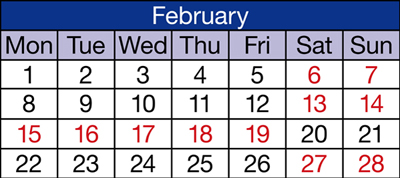
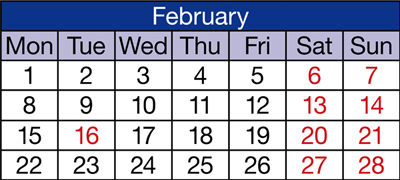
According to this calendar, either the weekend before or after the lunar calendar’s 1st of January is set as working days, and these two days are converted to two vacation days to be used consecutively to the three national holiday days. Adding this to the weekend gives you the seven-day holiday that is often spoken about. This year, it is the weekend after the New Year (20th and 21st of February) that has been designated as working days, making the seven-day holiday from the 13th to 19th of February.
I haven’t heard of any other country specifying that its citizens work on a weekend and take weekdays off instead, but this is common practice in China. It’s not better or worse, just different.
Since my Chinese company’s clients are mainly companies in Japan and Japanese subsidiaries in China, our staff have cooperated to allow us to stay open for almost the entire week so that we are available when Japanese companies are open.
This is the official holiday calendar for February 2010.
This is the HCI holiday calendar for February 2010.
Receipts in China
February 5th, 2010When I was setting up my office in China back in 2006, I had to go out and buy desks, chairs, computers, a refrigerator, etc., etc. I didn’t speak any Chinese at the time, so I was always accompanied with my first member of staff who would interpret for me. While I was expecting the price haggling, what I wasn’t prepared for was the question that we were always asked before the initial price was even quoted: “Do you need a receipt?” It soon became clear that things were cheaper without a receipt or, as the Chinese always explained it to me, things cost more if you wanted a receipt.
Having been bouncing back and forth between China and Japan for the past five years and now spending half my time in China, I am quite used to the idea, and it is indeed common practice in almost every industry.
Basically, there is a “sales tax” in China. That is, the person providing the goods or service pays a percentage of the sales price. This is not the same as the consumption tax in Japan or the VAT in Europe as it is not offset against the products or services you purchase. It is simply a cut of your gross sales.
The way that the tax is collected is very simple. In order to use something you purchase as an expense for a company or for any other official use, you need to have an official receipt which is issued by the tax office. The stores buy a book of receipts from the tax office, and each receipt is in triplicate: one copy each for the customer, the store, and the tax office. At the end of each month, the store reports to the tax office how many receipts it has issued and the total value. The tax office then deducts the tax from the stores bank account. In order to buy a new book of receipts, you need to give the previous book back to the tax office which then checks that all the receipts are accounted for and the amounts match with what you have reported.
So, if they don’t write an official receipt, they don’t pay the tax, and you get your purchase a little cheaper. Simple!
But, it gets complicated. I can’t speak for the whole of China—it’s a big place—but in Qingdao, where my Chinese company is based, it is common practice to give your client the official receipt with the invoice and for the client to transfer the money to your account a day or so later. There are concerns for both sides. Since once the seller has received the money, there is little incentive to write an official receipt as it will only mean they have to pay tax. This leaves the buyer without a receipt and unable to claim the purchase as a business expense. However, if the seller gives the buyer the receipt before receiving the money, then there is little that can be done if the buyer decides not to pay; after all, they already have both the product and a receipt for it.
One common way around this is for the person to come and collect the money and give the receipt in return, but this is not always possible even in the same town, let alone when doing business with somebody in another city. It is also problematic for a business like mine where most of our products are delivered via email.
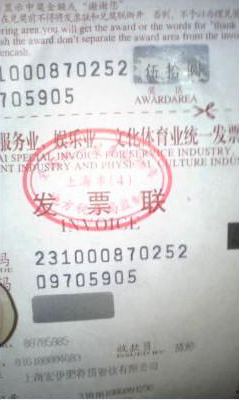
Of course, an official receipt is only really of interest to people who need it to be able to claim the purchase as a business expense. Eating out in China is very common and the government has come up with a very effective way of getting the ordinary person to ask for a receipt in a restaurant even though they don’t really need one. They have introduced an instant scratch lottery at the top of receipts issued in eating and drinking establishments. You scratch away the gray panel at the top to see what you have won. While most of the receipts just say “Thank you”, you can win amounts ranging from 5 to 100 RMB. Due to this lottery receipt system, it is quite common to see two registers in restaurants: one for those who want receipts, and one for those who don’t.
Here is a lottery receipt from a restaurant that has a prize of 50 RMB.