Archive for March, 2010

Felix — a friendly CAT

Friday, March 12th, 2010

There are now a variety of Computer Aided Translation (CAT) applications on the market. Most have their good and bad points, but one is in a class of its own. Felix, a CAT application developed by Ginstrom IT Solutions (GITS), which is run by a professional translator based in Okinawa, has all the benefits of your computer remembering what you have translated and showing you similar translations from the past so you can improve both your speed and consistency, but without any of the headaches and steep learning curves of the other software. Add in the fact that it costs less than most of the other CAT applications—most of which fail to perform even nearly as well as Felix does—and there’s not much left to think about.

Felix works inside Microsoft’s Word, Excel, and PowerPoint, and there is even a program called TagAssist that allows you to use it in HTML files. In addition to this revolutionary simple-to-use CAT software, Ryan Ginstrom, the owner of GITS and developer of Felix, also has a number of free applications (tools) that can be downloaded from his website.

While these tools can be used with Felix to further improve your translating efficiency, many of them can be used individually just to make life easier.

Count Anything is a small program that will give you a word count from a variety of file formats. Not only do you not need to open each file, but it will even count the words in those pesky text boxes, and there is an option to ignore sections that only contain numbers.

Analyze Assist is similar to Count Anything, but it also tells you how many of your sentences are duplicated within the file or files that you use it on. Also, if you use it in combination with a Felix translation memory file (TM), it will tell you how much of your file is in the TM, and allow you to quickly estimate how much work (= time = money) will be involved in translating the file.

These tools alone speed up the process of estimating how long it will take to do a translation, and that means you are already saving time (= money!!). All this for free!

If you still have any doubts whether Felix is worth the price, just download the fully-functional trial version. There is no limit to how long you can use it, and no functions are removed in the trial version. In fact, the only limitation is that you can only use memories with up to 500 lines in them. That should be plenty to give it a test run.

Ryan even offers a money-back guarantee. To quote from his website: “Any time within 60 days of your purchase you can ask for and receive a full refund, no questions asked.”

There is plenty more information about Felix and the various tools that can be used with it, so why not go any take a look around the site while you download the latest version for free, and take the friendliest CAT application for a test drive.

Blogs – Anywhere is OK?

Tuesday, March 9th, 2010

If you have your own website and are writing a blog, then there is no reason not to have the blog on your own website. I see many people with websites that include links to blogs on other sites. These are normally free, commercial blog sites.

It makes much more sense to have the blog on your own site. This is easy to do, and free! This blog uses WordPress and, as you can see from its URL, is firmly planted inside my own website.
The main advantages of having the blog on your own website are:

  • Not leading the visitor to another site and away from yours
  • Not having to worry about the free blog site disappearing
  • No annoying free ads and banners on your blog pages
  • Being in total control of all the content and settings yourself

    And as for the disadvantages . . . there aren’t any!

    So, if you have a website, why not start your own blog on your own site. And, if you still don’t have a website, why not start one; it’s cheap and easy, and comes with plenty of other benefits.

    One country, one time zone

    Saturday, March 6th, 2010

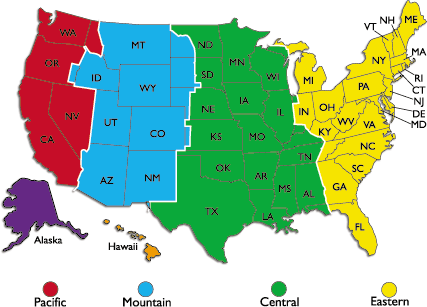
    Despite China having approximately the same size and breadth as the USA, while the USA is split into four time zones, China has only one. When it is 10:00 am in New York (GMT -5), it is still only 7:00 am in Los Angeles (GMT -8).

    The four time zones of the US can be seen on the map below.

    China, however, has only one time zone: GMT +8. This is the standard time zone for Beijing, but it is applied to all corners of the country.

    In 1912, under the Republic of China, five time zones were established in China, as shown on the Map below.

    These were kept until 1949 when the Republic of China was reorganized into the People’s Republic of China (PRC) which is what we now commonly refer to as “China”, and now only uses the single time zone of GMT +8.

    So, now China is the only country in the world to span at least four international time zones, but force its citizens throughout its regions to all use the same time. While this may have some advantages as seen from the seat of government in Beijing, it must lead to some dark mornings and bright evenings at the other end of the country. Of course, in the areas where agricultural is still the main industry, the local people often use their own local times, but the official time such as that used for airline flight schedules, etc. are still all based on the capital’s time.

    Just another example of how China is different to other countries. Not better or worse, just different. Here is a map of the world’s time zones, with China marked in red.

    People who speak your language

    Wednesday, March 3rd, 2010

    Probably the most common factor in the mistakes I’ve seen people make in China is them trusting the first person they met that happened to speak their language. This is more common with Japanese who go to China and meet somebody who speaks Japanese and then goes on to be their best friend introducing them to people who can do anything and solve all their problems. Hah!

    Imagine you are in a room of 100 people, all equally qualified to do a certain task, or to introduce you to other people, but only one of the 100 speaks your language. Who are you more likely to end up speaking with, working with, and trusting? Yes, that one person. Now, what is the chance that out of the 100, he or she was the best qualified for the job? 1% if you are naive enough to believe that they were there by chance, or somewhere below zero if you’d seen it happen as many times as I have.

    Still, it’s not difficult to understand. You are in a room with a group of people all smiling at you and giving you business cards you can’t read, and there is this single person standing next to you explaining who is who and what they do. Of course, this is the person you ask, and your instinct is to trust them. What would you do without them? The answer is: probably a lot better!

    There are a great number of Chinese people that make their livings by introducing unsuspecting foreign investors (that is what they like to call us) to people that can solve their problems. These problems can range from buying a simple commodity to getting your visa extended. There is always a cost, and your new friend always gets a commission. You, on the other hand, are highly unlikely to have been introduced to the best person for the job, and will certainly be paying much more than necessary for the goods or service. In all probability, you were introduced to the person willing to pay your friend the highest commission. The quality of the goods or the level of service is quite irrelevant.

    The best way to avoid this is to use an interpreter. That way you can speak with all the100 people, and deal with the person you choose—the person that you feel is best qualified for the job. But, be careful: there are also many interpreters that are really just there for the commission as well, so suspect everything, ask lots of questions, and be as careful as you can. Finding a good (trustworthy) interpreter is probably the first and most important thing to do when arriving in China to do business.

    Hint: The good interpreter that you can trust is NOT likely to be the cheapest you can find. The cheaper ones often have supplementary income in the form of commissions, bringing you back to the top of this page!