Archive for the ‘China’ Category

Fake or just different?

Friday, April 16th, 2010

Is there anything that isn’t copied in mainland China? I can’t think of anything right now. What can’t be copied is imitated to a degree somewhere between flattering and illegal, perhaps covering both ends of the spectrum.

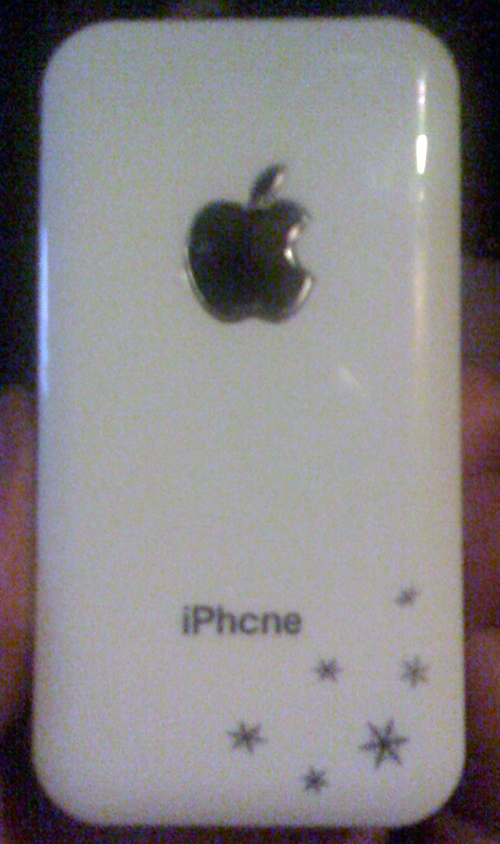
This is a mobile phone I came across last time I was in China (last month). While at first glance it appears to be an iPhone complete with Apple’s logo, a closer inspection reveals that despite the apple mark, it is not an iPhone, but an iPhcne.

While it does have a touch panel display, it is a fold-in-two normal mobile phone, and function-wise doesn’t bear any resemblance to the real iPhone.

I used to look for various spurious items in China. My mission now is to find something that isn’t copied.

One country, one time zone

Saturday, March 6th, 2010

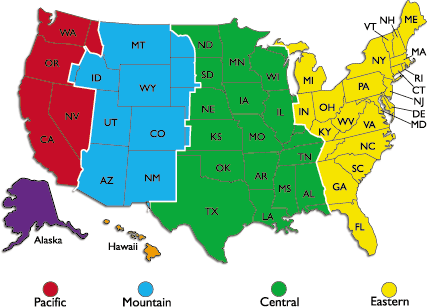
Despite China having approximately the same size and breadth as the USA, while the USA is split into four time zones, China has only one. When it is 10:00 am in New York (GMT -5), it is still only 7:00 am in Los Angeles (GMT -8).

The four time zones of the US can be seen on the map below.

China, however, has only one time zone: GMT +8. This is the standard time zone for Beijing, but it is applied to all corners of the country.

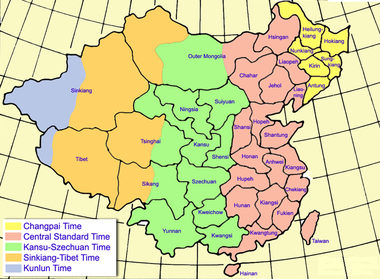
In 1912, under the Republic of China, five time zones were established in China, as shown on the Map below.

These were kept until 1949 when the Republic of China was reorganized into the People’s Republic of China (PRC) which is what we now commonly refer to as “China”, and now only uses the single time zone of GMT +8.

So, now China is the only country in the world to span at least four international time zones, but force its citizens throughout its regions to all use the same time. While this may have some advantages as seen from the seat of government in Beijing, it must lead to some dark mornings and bright evenings at the other end of the country. Of course, in the areas where agricultural is still the main industry, the local people often use their own local times, but the official time such as that used for airline flight schedules, etc. are still all based on the capital’s time.

Just another example of how China is different to other countries. Not better or worse, just different. Here is a map of the world’s time zones, with China marked in red.

People who speak your language

Wednesday, March 3rd, 2010

Probably the most common factor in the mistakes I’ve seen people make in China is them trusting the first person they met that happened to speak their language. This is more common with Japanese who go to China and meet somebody who speaks Japanese and then goes on to be their best friend introducing them to people who can do anything and solve all their problems. Hah!

Imagine you are in a room of 100 people, all equally qualified to do a certain task, or to introduce you to other people, but only one of the 100 speaks your language. Who are you more likely to end up speaking with, working with, and trusting? Yes, that one person. Now, what is the chance that out of the 100, he or she was the best qualified for the job? 1% if you are naive enough to believe that they were there by chance, or somewhere below zero if you’d seen it happen as many times as I have.

Still, it’s not difficult to understand. You are in a room with a group of people all smiling at you and giving you business cards you can’t read, and there is this single person standing next to you explaining who is who and what they do. Of course, this is the person you ask, and your instinct is to trust them. What would you do without them? The answer is: probably a lot better!

There are a great number of Chinese people that make their livings by introducing unsuspecting foreign investors (that is what they like to call us) to people that can solve their problems. These problems can range from buying a simple commodity to getting your visa extended. There is always a cost, and your new friend always gets a commission. You, on the other hand, are highly unlikely to have been introduced to the best person for the job, and will certainly be paying much more than necessary for the goods or service. In all probability, you were introduced to the person willing to pay your friend the highest commission. The quality of the goods or the level of service is quite irrelevant.

The best way to avoid this is to use an interpreter. That way you can speak with all the100 people, and deal with the person you choose—the person that you feel is best qualified for the job. But, be careful: there are also many interpreters that are really just there for the commission as well, so suspect everything, ask lots of questions, and be as careful as you can. Finding a good (trustworthy) interpreter is probably the first and most important thing to do when arriving in China to do business.

Hint: The good interpreter that you can trust is NOT likely to be the cheapest you can find. The cheaper ones often have supplementary income in the form of commissions, bringing you back to the top of this page!
Cheated in China?

Saturday, February 27th, 2010

Here in Japan, I am constantly being told stories of how people went to China on business, either to buy or sell something, or to establish a company, and ended up being cheated.

While I won’t say that nobody is ever cheated in China—people are cheated every day in all countries—I can say that almost all of the stories I have heard can be explained by greed on the part of the person going to China, or a total misunderstanding and/or lack or even wanting to understand the Chinese people, language, or how business is done in China. Basically, they went there with their own set of preconceptions and common sense, and either just expected them to hold true in China or tried to enforce them there. A recipe for disaster!

All countries and cultures are different, but China is very different. Before going you need to know a little about these differences, or at the very least accept that they exist and be prepared to work with them.

And don’t trust the first person you meet who just happens to speak your language. But more about that later . . .

Chinese myths 101

Friday, February 12th, 2010

People tell you a lot about China: the country, the people, the politics, the language, the culture . . .

But, how many of these people have come any closer to China than their local Chinese take-away restaurant?

Since first visiting China in 2005 and then establishing my company in China in 2006, I have come to realize that much of the information about China is somewhere between misinformation and disinformation. Deliberate or otherwise, people are getting the wrong impression about a lot of things.

While I don’t promise to give you the 100% truth about China, I’ll try and dispel some of the common knowledge that is more fiction than fact. Then again, China is a big place and I don’t believe there is anything 100% true that can be said about the entire country.

I’ll also try and explain how some of the preconceptions I had about China before I visited and after I had only been there a short time have changed over the last five years.

Again, I don’t promise for it to be an absolute explanation. My opinions about China change with the amount of time I spend there. Then again, China is changing as well, and quickly!

Either way, it has to be better to know more than less about a country that is having a great affect on the global economy: an affect that is only going to increase with time.