Archive for the ‘International exchange’ Category

How we met

Monday, May 24th, 2010

I’m British and my wife is Japanese. We are always being asked how we met.

In 1998, I went back to England for the first time after leaving in 1991. The cheapest flight I could find was Hiroshima to London via Singapore. On the same day my wife left Japan to spend a year in England studying English. She also looked for the cheapest flight she could find, and ended up flying from Tokyo to London via Singapore. So, we ended up on the same flight from Singapore to London.

It was a large aircraft with 3 seats, 4 seats, and 3 seats across. I was seated on the leftmost seat in the middle, and my wife was seated on the rightmost seat. In between us was a married couple, with the wife sitting next to me. From the moment I sat down, the lady next to me started to ask me questions. The first was, “Where are you going?” which seemed a little strange since we were sitting on an aircraft bound for London.

The questions continued.

Where do you live?  :  Japan

What do you do there?  :  Translation and interpreting

Can you speak Japanese?  :  Yes

Is she (girl three seats away from me) Japanese?  :  No idea!

As soon as I said I didn’t know where the girl was from she leaned across her husband and asked, “Are you Japanese?” The somewhat confused girl gave her a puzzled look and just answered, “Yes.” That was enough. As she was explaining, “He speaks Japanese, so you should sit here”, she was already standing up and removing her baggage from the overhead compartment. The aircraft was already taxiing along the runway, and the stewardesses were all buckled into their seats, but that didn’t stop her from switching seats with the girl in the other aisle. Looking back now, I think she just wanted an aisle seat for herself, but it was all over before anybody could stop her, and there we were for the next 15 hours.

The girl that had been planted next to me was on her way to the UK to study English. She had worked three jobs to save up enough money, and hadn’t borrowed anything from her parents. She didn’t speak any English at all, and said that she thought it would be better to just go to the UK and learn than waste time and money trying to study in Japan. After the 15-hour flight, we arrived at London’s Heathrow Airport and collected our suitcases. She was obviously confused about where to go and what to do, I decided to help her through the immigration procedures, and help her find the person from the English school that was there to meet her. On finding the correct school, and confirming that her name was on the list, I turned to go back to my father who had come to meet me. She still seemed unsure of herself, and a little scared, so I explained that while I would be going to Mexico with my parents for a couple of weeks, and then returning to Japan six weeks later, that if she had any problems she could always call my parents who would try and help. So, I wrote down my parents’ telephone number for her, and left to find my father. I didn’t know her family name, and never imagined that she would get in contact.

However, . . . the evening before I was scheduled to return to Japan, she called my parents’ house. “Thank you for your help that day. I’m settled in at my home stay now. I’d like to send you a postcard, so please tell me your address”. I didn’t really expect her to send a card, but told her my parents’ address in the UK. And, as planned, I returned to Japan the next day.

A couple of months later, my parents told me that a postcard had arrived. I just told them to send it out the next time they sent something. The postcard eventually arrived, so I sent a postcard back. Then a letter came, so I replied with a letter. We kept in touch while she was in the UK by letter, and then by email when she returned home (to Saitama). One day, she asked if she could “come and see Fukuyama”, and so she did. That was October 1999, more than a year after we had met on the plane. We met again in Tokyo when I went there on business, and agreed that she would spend the New Year’s holiday in Fukuyama. Over the New Year we decided to get married. That was the fourth time we had met. I went to visit her parents in February, and she moved to Fukuyama on the 1st of May 2000.

International marriages involve some paperwork and time, and when that was all prepared we decided to register our marriage on the second anniversary of the day we met on the plane.
Alcohol and business dinners

Tuesday, May 18th, 2010

If you think that alcohol and business don’t go together, perhaps you’d better stay away from China. They don’t only go together; I’d go so far as to say, “no alcohol, no business”. While the concept of discussing business or just getting to know people during dinner and a drink may be commonplace in many countries, China takes it a step further.

My first visits to China were as a member of a group of businessmen from Japan invited to see various cities in China, and be encouraged to “invest” in their cities, which each had their attractions and carefully-named “development zones”.

Typically, our group would consist of half a dozen members, and we would be greeted by high-ranking officials from the local municipality, managers of the development zones, local businessmen involved in international trade, and various other bodies to fill the room and totally outnumber us. At first, it seemed as though this was all part of the VIP treatment that we normally received, which often also included police escorts into town through red lights and all. But, first impressions can be deceiving, especially in China . . .

So, the first morning, after taking a tour of a (partially developed) development zone, we would be invited (taken!) to lunch with a dozen or so local people. They would range from factory managers to the mayor. In addition to the beer (served cold if we were lucky), we would be treated to the local variety of white spirit (baijiu). This ranges in alcoholic content from about 35% to 75%, and in taste from bad to worse.

The tradition, if that’s what you call it, or custom is for each person on the visiting side of the table to drink a glass of this local spirit with everybody on the welcoming side of the table. Remember, that’s six of us and at least twelve of them. Yep, it’s an us and them game! Competitive drinking at its worst. With six of us, and twelve of them, it means that for every “round” of drinks, we each get to drink twelve glasses, and they each get to drink six. If that doesn’t sound fair, it is only later that you learn how they are often only drinking water or tea, while you are being treated to the local 55% alcohol fire-water. And, it’s still just lunchtime!

After another tour of a port, or maybe a two-hour seminar (a good place for a sleep) with impossible-to-comprehend literature (they tell it’s been translated into your language, but . . .), you get 30 minutes in your hotel room before the dinner starts at about 6:30 pm.

Dinner is usually a selection of the best the region can offer. This can range from sea cucumbers, scorpions, and fried insects to things you can’t recognize but don’t have the courage to ask about. And, yes, of course, the drinking. It is basically the same as at lunch but with the volume turned up: bigger glasses and more toasts.

After dinner, you are typically taken drinking at a local karaoke establishment where you are looked after by young ladies that speak your language. There, the normal beverage is warm beer.

Why drink that much?

Well, they don’t drink so much as make sure that their guests do. There are varying reasons given for this, but the most convincing to date is that people tend to reveal their true selves when they are somewhat inebriated, and the Chinese like to see the true person, flaws and all, before they even consider doing business with them. Another reason given, which I have experienced myself numerous times, is that they will ask the same question several times from different angles. At first it seems as though they are either stupid or forgetful, but they are not. They are calculative, smart, and relatively sober! They will ask you about a date. When that was, how old you were then, how many years ago it was, how old you are now, etc. They are, of course, making sure that the answers you gave at lunchtime, before you started drinking, and after you are suitably pickled are all the same. Not a problem, as long as you are telling the truth.

How to avoid drinking

Basically, you can’t. Unless you tell them the very first time you meet them that you do not drink—cannot drink—any alcohol, you will be socially obliged to drink “just a little”, and that soon escalates into “just too much”. Even taking a sip for the first toast is enough to let them know that you can drink if you want to.

Not drinking is an option, as is stopping when you feel you have had enough. However, you should be aware that refusing their drinks is tantamount to refusing their business.

Interpreters

I’d also warn you to beware of the young ladies from the local municipal offices that are brought along as your interpreters. It is quite often that they will not be able to finish their glass of whatever is being drunk at the time and you, as a gentleman, will be expected to drink it for them. It isn’t unusual for these interpreters to ask for red wine as they “really don’t like the baijiu” (as if any of us do!), and then just take a sip leaving you to finish the glass of wine after your warm beer and baijiu.

Summary

On the brighter side, while it may take several years and a lot of honesty on both sides, once you become more than just prospective business partners, the amount of alcohol decreases dramatically, and it is not uncommon for Chinese officials to only request tea at lunch meetings explaining that they have to drink with “new people” that evening.

All in all, I’d say that the Chinese tend to look at people and ask themselves if they can do business with them in ten years time. Whereas as the Japanese tend to look at people and try to calculate the profit from the deal on the table.

Just different policies and different cultures, but here I think I prefer the Chinese way of thinking. Just their way of thinking in the long term, not their choice of alcohol!

Bribes in China

Saturday, May 8th, 2010

Whenever the subject of doing business in China is mentioned, so are bribes. There is no denying that “bribes” are still a part of daily life in many aspects of doing business in China. It is so common that it is rarely even thought of as being wrong. Paying bribes is common sense in today’s China, and trying to do things “the right way” is often just seen as going against common sense and displaying your ignorance of how things get done when you are trying to get something done. It might be better to think of the bribes more as just “the expense of doing business” or a “fee” to get something done.

These bribes can be divided into two main categories: “good bribes” and “bad bribes”. Let me talk a little about that first.

● Good bribes

A good bribe is when you pay somebody to do something they should be doing anyway. It is a little grease to speed things up, which may take much longer than necessary without it. For example, when applying for a visa renewal, the person at the desk can make the process much more complicated and painful than it really needs to be. They can ask for documents that aren’t listed as being required in the regulations, they can interpret the regulations to mean that you have written something incorrectly and need to rewrite the entire document; these “corrections” can go on forever. However, without that persons stamp on your application you can’t proceed to the next stage of the process. Even though you are just trying to do the right thing the right way, for some reason it always seems to take far more time and energy that it is supposed to. In times like this, and there are many of them, giving the person at the desk a small “gift” can suddenly speed things up and make all those small problems go away. The result is just that your application proceeds according to the rules, you save a lot of time, and nobody has broken any laws. That gift (bribe) means that your application goes much quicker and smoother. This is so common at city halls, banks, police stations, hospitals, that it is no more than common sense.

In some cases, instead of giving a gift, you can just have “a friend” make a telephone call for you. This too can make all the problems go away and bring your application to the top of the pile. However, don’t be fooled into thinking that having somebody make that phone call will end up being any less expensive than the gift would have been. It’s much more complicated than that. (More about that another time . . .)

Bad bribes

On the other hand, a bad bribe is where you pay somebody to do something they shouldn’t do. For example, you might want somebody to overlook a small infraction of rule, or you might want somebody to break a rule for you. These kinds of bribe are less common than the good bribes, but are usually more expensive and much more dangerous.

You should never be the one to suggest such a bad bribe. If you bring up the idea, you could get arrested and that would just lead to more bribes! If the other person brings up the possibility of something getting done if you were to do something for them or give them a gift, you should think carefully about it. Whenever possible, consult a local friend before even agreeing to the idea, as there have been many cases where people have found themselves in a lot of trouble trying to bribe the wrong person.

How to know if it is a “good” or “bad” bribe

This is quite simple. For example, if you are trying to get something through customs, but are running into lots of paperwork and questions, and then you are told that all can be fixed for a certain price. All you need to do is ask yourself whether or not those goods should be allowed through customs.

If there is no real reason for the customs officer to be delaying your shipment, and you are just being made to go through lots of extra time-consuming hoops, then the chances are that it is a good bribe that is being proposed. On the other hand, if you know that the goods really shouldn’t get through customs, but you can get them through for a price, then there is little doubt that this is a bad bribe.

How to pay a bribe

There are many ways that these gifts are given in China. Though it may seem obvious, it is important to remember that nobody is going to give you a receipt for a bribe and, even if they did, you couldn’t use it as a company expense. Also, if you are seen giving, or the official is seen receiving cash, things can get ugly and complicated very quickly.

So, instead of giving cash, it is now very common to give prepaid cards to charge mobile phones, or gift certificates that can be used in local department stores. Everybody has a mobile phone and these prepaid cards can be used to charge any phone. The department store gift certificates, especially those for Japanese stores, have a certain social status attached to them. In addition to avoiding handling cash, there is another advantage of using these two items as gifts: when you purchase them, you are issued with an official receipt so the purchase can be written off as a company expense.

However, before you start criticizing these practices in today’s China, think back to how things were in Japan and other countries soon after the Second World War. In Japan, the same character used to write bribe was often read in another way and was used to mean a “gift given to show appreciation”. Vouchers that could be used to buy rice were a very common gift in the years after the war in Japan. I don’t think anybody would try and claim that bribes are no longer given in any society; it is just that the form of the bribes and the ways they are paid have changed with the times.

When in China, do as the Chinese do!

Holding hands

Sunday, April 4th, 2010

Different countries, different cultures, different norms. Nothing to be surprised about.

Yet, much of what people see in other countries does surprise them. One example is people holding hands in public.

Close your eyes and imagine two people walking down the street holding hands. Now, is one male and the other female, or are they of the same sex? Your answer is likely to be highly dependant on where you are from.

While in the UK, USA, and Japan, the only time you would see two adults holding hands would be when they are romantically involved couple, normally (but not always) male and female.

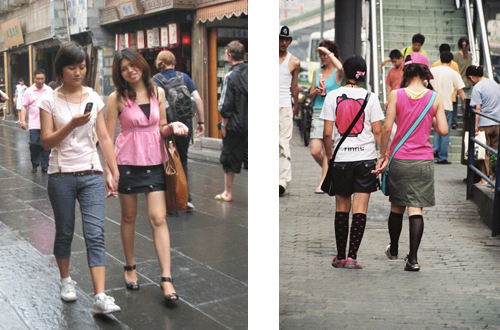
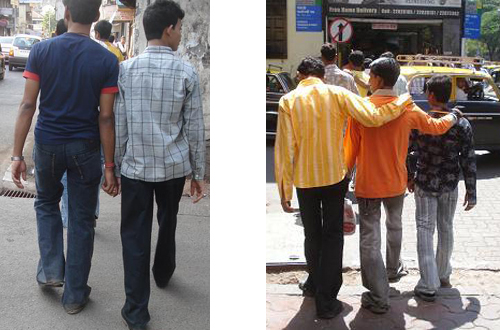
However, this is not true in all countries. For example, it is very common to see two young women walking down the street holding hands in China, and the same with two young men in India. It is not a sign of any romantic affection, just of friendship.

Women holding hands in China


Men holding hands in India

Why Fukuyama?

Friday, March 26th, 2010

Why not? After deciding to spend a year in Japan, the next thing to do was look for somewhere to work. I soon received three offers of employment as an English teacher.

  1. A small town in Saga Prefecture (JET program)
  2. A small private school in Fukuyama
  3. A large private school in Tokyo

As I new absolutely nothing about Japan at the time, I opened a map to look for the three locations.

Saga Prefecture looked very green on the map, and I imagined somewhere with few buildings. Tokyo I knew as the capital, and I really didn’t want to spend my time in a large international city where I imagined a lot of people would speak English. As for Fukuyama, it wasn’t on the map, but a little research told me that it was midway between the town in Saga Prefecture and Tokyo, both in size and geographically. So, I picked the one in the middle: Fukuyama.

At the time, I only planned to stay in Japan for a year, and was sure that I could easily move to another city if I didn’t like, or got bored with, Fukuyama. I simply haven’t got bored with it yet!